What Is the Trek to Everest Base Camp?
The trek to Everest Base Camp is a ~130 km round-trip walk through Nepal's Khumbu region, starting and ending in Lukla, that brings you to the foot of the world's highest mountain at 5,364 m (17,598 ft). You'll walk about nine of the 12–14 days, sleeping in mountain lodges the whole way, with the trail winding through Sagarmatha National Park past Namche Bazaar and the Tengboche monastery. If money's the thing on your mind, skip ahead to the costs.
One thing that confuses nearly everyone at first: there are two Base Camps. The one you trek to is South Base Camp in Nepal, at 5,364 m. North Base Camp sits across the border in Tibet at 5,150 m, and you drive there on an overland tour rather than walk. And no, trekking to Base Camp isn't climbing Everest: those $40,000+ price tags belong to summit expeditions, which are a completely different world of permits, oxygen, and risk.
Which route variants exist?
There are four ways to do this, and they all end at the same place:
- Classic EBC trek: 14 days, walking both directions. This page plans this one.
- EBC via Gokyo Lakes: 13+ days, swinging past the turquoise lakes and Gokyo Ri.
- Three Passes trek: 18 days over Kongma La, Cho La, and Renjo La, for experienced legs.
- Heli-return trek: 11 days, where you walk up and fly home from near Kala Patthar.
The mountain doesn't move and neither does the trail. What changes is the bill, so let's talk about that first.
What Does the Everest Base Camp Trek Cost?
A guided Everest Base Camp trek runs $1,250–1,800 per person on the standard 14-day package, and that covers your permits, Lukla flights, lodge beds, meals, and a licensed guide. The wider market runs from about $950 if you strip everything down to $5,000 if you want luxury lodges. Going solo costs more per person; get three friends together and everyone's rate drops.
Here's where the money actually goes:
| Item | Typical cost (USD, 2026) | Notes |
|---|---|---|
| Guided 14-day package | $1,250–1,800 | Permits, flights, lodging, meals, guide included |
| Lukla flights (if booked solo) | $238 KTM / $188 Ramechhap one-way | ~$400 return all-in |
| Permits | $40–50 combined | Two permits; see permits |
| Nepal visa | $50 | 30 days, on arrival |
| Travel insurance | $100–250 | Must cover 6,000 m + helicopter evacuation |
| Tips | $100–200 total | ~$15/day guide, ~$8/day porter, per group |
| Drinks, wifi, charging, showers | $200–400 | Prices rise with altitude |
| Water | $1–2/L low, $3–6/L high | Boiled teahouse water: NPR 150–450/L |
One number deserves your full attention: an uninsured helicopter evacuation from Gorak Shep costs $4,000–6,000. Whatever you trim from this budget, don't let it be the insurance.
A few money habits will save you real stress up there. Carry Nepali rupees from Kathmandu, because there aren't reliable ATMs past Namche Bazaar and everything on the trail is cash. Expect prices to climb with the altitude too: the water bottle that cost you $2 in Lukla is $5 by Gorak Shep, and that hot shower goes from $3 to $10 along the way. And remember the budget above assumes things go to plan; flight-delay nights, side trips, and last-minute gear from Namche's shops (they exist, at a markup) all sit outside it.
Wondering about doing it without a package? The independent math comes to roughly $900–1,100 for rooms, flights, permits, and food before you've hired anyone. What the extra money in a $1,250–1,800 package buys you is the licensed guide Nepal's 2026 rules now expect, a porter, rooms that are actually booked in peak season, and someone else fighting for your seat when Lukla weather cancels the flight. You're mostly paying to make problems disappear.
What moves the price?
Five things decide your final number:
- Group size: on your own you'll pay ~40% more than the 4–6-person rate.
- Service level: how many porters per trekker, what class of room, which Kathmandu hotel.
- Season: the peak windows (October–November, March–May) carry the highest prices.
- Trek length: the 11-day heli-return is pricier despite being shorter, and the helicopter is why.
- Guided vs independent: going independent trims the package fee, but Nepal's 2026 guide rules mean you should plan around a licensed guide anyway. More under permits.
Once you've pinned those five down, your price range collapses into an actual price, and that's exactly what a defined package does for you.
Everest Base Camp Trek Packages and What They Include
A proper Everest Base Camp trek package covers your flights to Lukla, a licensed English-speaking guide, a porter for your duffel, your teahouse beds, three meals every trekking day, and both permits. What's almost never included: insurance, drinks, tips, personal gear, your international flights, and the Nepal visa. Read both lists carefully before you pay anyone, always.
The packages behind this site's planning come from Himalayan360 in Kathmandu, which holds 5/5 on TripAdvisor, an "Excellent" rating on Trustpilot, and 5/5 on Google Reviews:
| Package | Days | From (pp) | Best for |
|---|---|---|---|
| Everest Base Camp Trek | 14 | $1,260 | First-timers; the standard plan |
| EBC Trek + Helicopter Return | 11 | $2,150 | Tight schedules; skip the descent |
| Gokyo Lake Trek | 13 | $1,200 | Lakes and Gokyo Ri over Base Camp itself |
| Everest Three High Pass Trek | 18 | $1,485 | Experienced trekkers; the full circuit |
| EBC Helicopter Tour | 1 | $1,070 | See EBC without trekking |
| Everest Mountain Flight | 1 hr | $215 | The budget aerial option |
Group pricing works in your favor here: that 14-day classic drops from $1,815 if you're alone to $1,290 per person in a group of 13–20.
Should you pay for the helicopter return? Here's the honest version: $890 extra buys back 3 days, swapping the two-day walk down for a 45-minute flight. If your return date is fixed, it's worth every dollar. If your budget is the fixed thing, walk down.
Our trek began at Lukla with our seasoned guides who had in-depth knowledge of the trail, coupled with a genuine passion for the region.
Want an exact price for your dates?
Whichever package you pick, the days on the trail look the same. Here's how they unfold.
How Many Days Do You Need for Everest Base Camp?
You need 12–14 days door to door from Kathmandu, and that includes 9 trekking days plus 2 built-in acclimatization days. Here's the standard 14-day plan:
| Day | Stage | Sleep altitude | Hours |
|---|---|---|---|
| 1 | Arrive Kathmandu | 1,400 m | — |
| 2 | Fly Lukla, trek to Phakding | 2,610 m | 3–4 |
| 3 | Phakding → Namche Bazaar | 3,440 m | 6–7 |
| 4 | Acclimatization day, Namche | 3,440 m | 3–4 hike |
| 5 | Namche → Tengboche | 3,860 m | 5–6 |
| 6 | Tengboche → Dingboche | 4,410 m | 5–6 |
| 7 | Acclimatization day, Dingboche | 4,410 m | 3–4 hike |
| 8 | Dingboche → Lobuche | 4,940 m | 5–6 |
| 9 | Lobuche → Gorak Shep → EBC → Gorak Shep | 5,164 m | 7–8 |
| 10 | Kala Patthar sunrise → Pheriche | 4,371 m | 7–8 |
| 11 | Pheriche → Namche | 3,440 m | 6–7 |
| 12 | Namche → Lukla | 2,860 m | 6–7 |
| 13 | Fly Kathmandu | 1,400 m | — |
| 14 | Depart | — | — |
Don't think of days 4 and 7 as rest days, because they aren't. Each one sends you up high on a day-hike and brings you back down to sleep, which is exactly how your body learns to cope with altitude. Trekkers who skip them are the ones who end up in trouble; this schedule manages oxygen, not kilometers.
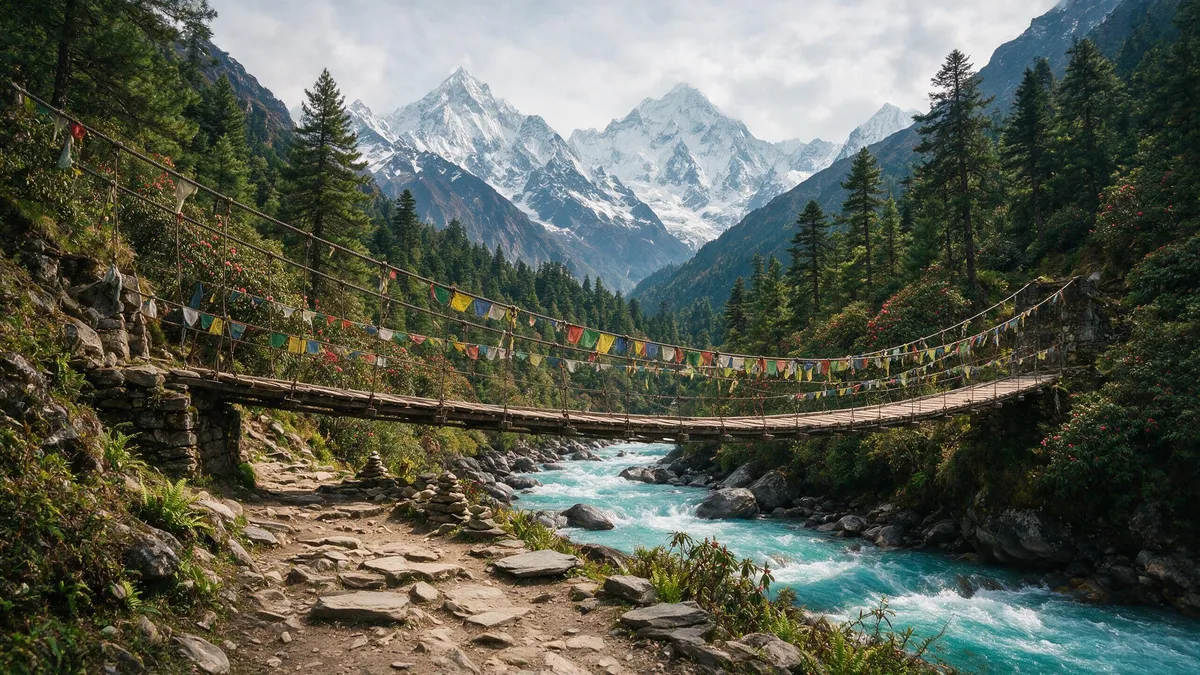
The days themselves are worth looking forward to. On day 3 you'll cross the Hillary Suspension Bridge over the Dudh Koshi before that long climb into Namche Bazaar, a market town stacked inside a natural bowl, with its famous Saturday market. Day 5 delivers you to Tengboche Monastery, the biggest gompa in the Khumbu, where Ama Dablam looms straight over the courtyard. And day 9 gets you to Base Camp itself: a canvas city of several hundred expedition tents spread across the Khumbu Glacier if you come in April or May, or the bare glacier and its prayer-flagged marker in autumn. That night you sleep at Gorak Shep, which was the original Base Camp for the 1953 expedition.
Can you go faster? Sort of. The 11-day heli-return skips the walk down, and that's a fair shortcut. What you can't safely skip are the acclimatization days: a 10-day walking itinerary is a higher chance of altitude sickness, not a better deal. The schedule is built around how hard this actually is, so let's talk about that honestly.
How Difficult Is the Everest Base Camp Trek?
The Everest Base Camp trek is demanding but non-technical, which means no ropes, no climbing, and no mountaineering background needed. It's a long walk where the air gets thin. You'll cover 8–15 km and 5–7 hours a day on rocky, stepped, sometimes steep trails, and the real test is doing it nine days in a row rather than any single day.
If you're a beginner wondering whether this is out of your league: it isn't, provided you respect it. You'll want to be comfortable walking 5–7 hours two days running with only a light daypack, plus the standard acclimatization schedule rather than a shortened one. There's no official completion statistic, but operators report most trekkers on 12–14-day itineraries make it to Base Camp.
Give yourself 8–12 weeks of training:
- Train your cardio 3–4 times a week with hiking, stair climbing, running, or cycling.
- Stack weekend hikes back-to-back, 4–6 hours each, carrying a loaded daypack.
- Climb stairs or hills carrying 8–10 kg from week 4.
- Wear in your boots completely, because fresh boots are how treks end early.
Your average day starts at 7–8 am after breakfast, runs 3–4 hours to lunch, then another 2–3 to the night's teahouse, aiming to arrive by mid-afternoon. You only carry a daypack (water, layers, sun protection, camera) while your porter moves the duffel ahead of you. The ground shifts between valley paths along the river, long stone staircases, and open glacier moraine above Lobuche, and none of it needs your hands.
For a benchmark, think Kilimanjaro-level overall effort: EBC keeps you at altitude for more days, while Kilimanjaro squeezes into one higher summit night at 5,895 m. Compared with the Inca Trail, this one is longer, higher, and colder. And here's the thing about who makes it and who doesn't: the dominant failure cause is going up too fast, not weak legs.
Everest Base Camp Altitude and How to Acclimatize
Everest Base Camp sits at 5,364 m (17,598 ft), where every breath gives you roughly half the oxygen of sea level. The trek's real high point, the Kala Patthar viewpoint, adds another 181 m at 5,545 m. So the thing to respect on this trek isn't the terrain, it's the air, and the good news is that a proven routine handles it.
Acute mountain sickness (AMS) can hit anyone above about 2,500 m, fit or not. It starts as a headache, nausea, tiredness, or bad sleep. The severe forms, HACE (swelling in the brain) and HAPE (fluid on the lungs), are genuine emergencies. Your risk is decided by how fast you ascend, not by how fit you are.
Your itinerary is your protection:
- Two acclimatization days: one at Namche (3,440 m), one at Dingboche (4,410 m), each built around a climb-high-sleep-low day-hike.
- Slow gains above 3,000 m: your sleeping altitude climbs only ~400–500 m per day, inside accepted guidelines.
- Hydration and pacing: your guide keeps you honest on both, since dehydration both mimics and worsens AMS.
About medication: plenty of trekkers carry acetazolamide (Diamox) after talking to their doctor before the trip, and good guides carry oximeters and check your readings daily. Neither one replaces the acclimatization days, and no tablet turns a 10-day itinerary into a safe one.
Two questions that come up constantly. The "2 pm rule" you've read about is a summit climbers' turnaround convention: get to the top by early afternoon or turn around. Your version of it is simpler: be at your teahouse by mid-afternoon, before the weather turns. And check your insurance certificate for the number 6,000 m with helicopter evacuation included, because standard travel policies stop covering you at 3,000–4,000 m and won't pay for an airlift from Gorak Shep.
Altitude has a calendar side too. Bad weather shrinks your safety margins, which makes picking the right season part of staying safe.
When Should You Trek to Everest Base Camp?
October–November and March–May are the windows to aim for. Autumn after the monsoon gives you the clearest air of the whole year, and spring gives you warmth, rhododendron blooms, and the buzz of expedition season at Base Camp itself.
| Months | Conditions | Crowds | Lukla flights |
|---|---|---|---|
| Oct–Nov | Clearest views, stable, cold nights | Peak | Mostly via Ramechhap |
| Mar–May | Warm days, blooms, some late haze | High | Mostly via Ramechhap |
| Dec–Feb | Clear and very cold (−15 °C nights up high) | Low | From Kathmandu |
| Jun–Sep | Monsoon: cloud, rain, leeches low down | Lowest | Frequent cancellations |
Winter can work if you don't mind serious cold: quiet trails, knife-sharp views, and some teahouses running a reduced service. The monsoon is the one season to skip, because the mountains disappear and the flights keep failing. Your season choice even determines the airport where your trek begins, and that catches almost everyone by surprise.
Getting to Lukla: How the Trek Begins
Your trek starts in Lukla (2,860 m), and you'll fly there: a 30-minute flight out of Kathmandu, or a 20-minute hop if you leave from Ramechhap. Here's the surprise: during the busy windows (October–November and March–May), most flights to Lukla actually depart from Ramechhap/Manthali airport, a 4–5 hour pre-dawn drive from Kathmandu, because Kathmandu's own airport is too congested. Off-peak, you fly straight from Kathmandu. Tickets run $238 from Kathmandu and $188 from Ramechhap, one-way for foreign nationals.
Why all the weather drama around this one airport? Tenzing-Hillary Airport has a single sloped runway just 527 m long at roughly a 12% gradient, with a mountainside behind it and a drop-off in front. Pilots fly it entirely by sight: no instrument landings, which is why cloud shuts the whole place down. The pattern is reliable, though — mornings fly, afternoons don't. So take the earliest flight you can get, and plan around cancellations like this:
- Give yourself 1–2 buffer days before any international connection.
- Take morning flights first, since afternoon slots get cancelled far more often.
- Remember helicopters fly in weather that grounds the planes: $450 per seat shared, ~$3,500 for a private charter.
- Consider the road option too (drive to Surke/Thamdanda and walk in), which adds 1–2 days each way.
If you're on a package, your operator rebooks the flights when weather intervenes; if you're independent, that scramble is yours. Once you land in Lukla, you'll hit the first permit checkpoint within a day's walk, so let's get your paperwork straight.
What Permits Do You Need for Everest Base Camp?
You need two permits for the standard route, and they're checked at Lukla and Monjo:
| Document | Cost (foreigners) | Where |
|---|---|---|
| Sagarmatha National Park Entry Permit | NPR 3,000 (~$22) | Kathmandu or Monjo gate |
| Khumbu Pasang Lhamu Rural Municipality Permit | NPR 3,000 (~$22) | Lukla |
| Nepal tourist visa | $50 / 30 days | On arrival, airport |
Together the permits come to roughly $40–50. If you walk in from Jiri instead of flying, you'll also need a Gaurishankar Conservation Area permit. On a package, all of this is handled for you.
And the guide question, since you're probably wondering: Nepal has been moving to require licensed guides across the Everest region, and with 2026 enforcement inside Sagarmatha National Park, a guided trek is the sensible planning assumption. Honestly, the rule just formalizes what the safety picture already said — a licensed local guide is the most valuable line in your whole budget.
What to Pack for Everest Base Camp
Build your packing around one item: a sleeping bag rated −10 to −20 °C. The teahouses give you a bed and blankets, not warmth after dark. Seven categories cover everything:
- Layered clothing: base layers first, then fleece, an insulated jacket, and a waterproof shell
- Broken-in boots and a pair of camp shoes
- Sleeping bag rated −10 to −20 °C, with a liner
- Sun protection: glasses, cream, and a hat, because high-altitude sun burns even through cold air
- Water treatment: tablets or a filter, since untreated tap and stream water is never safe up here
- First aid and personal meds: including blister care and any altitude medication you've been prescribed
- 30–40 L daypack: your porter takes the duffel, up to ~10–15 kg
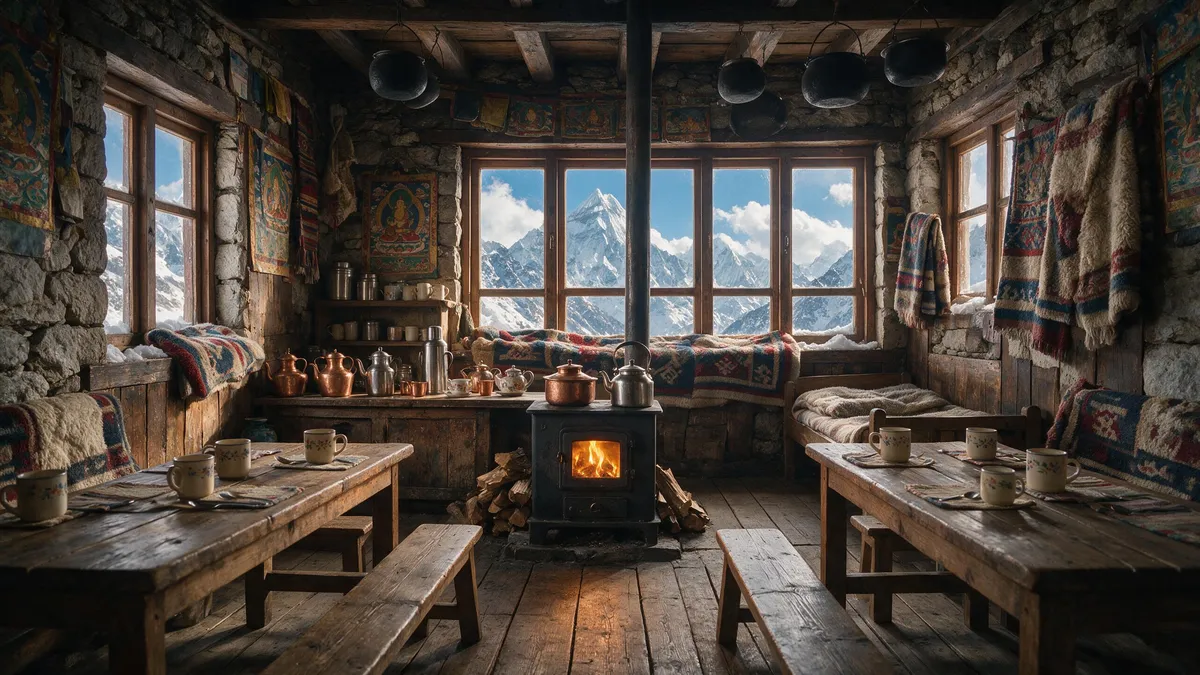
Life on the trail is simpler than you might expect. You'll sleep in twin rooms with shared bathrooms, eat a lot of dal bhat (it's the best thing on every menu, and refills are the custom), and pay per use for charging, wifi, and hot showers at prices that climb with the altitude. The rooms aren't heated; the dining room stove is the only warm spot after dark, which is why that sleeping bag rating matters so much. One more tip: Namche is your last real shopping stop, so if something got left behind, its shops can fix that for a markup; beyond Namche, nobody can. The extras budget is in the cost table. With the duffel packed, there's just one question left, and it's the one you probably started with.
Is Everest Base Camp Worth It?
For most trekkers, yes — as long as you know one thing going in: you can't actually see Everest's summit from Base Camp, because Nuptse stands in the way. Your reward moment comes the next morning on Kala Patthar, when Everest, Lhotse, and Ama Dablam catch the sunrise across the Khumbu Glacier. What you're really buying with those two weeks is the whole accumulation: nine days walking through the world's highest scenery, Sherpa villages and monastery mornings, and a finish line at the most famous address in mountaineering.
As we trekked through diverse landscapes, I was spellbound looking at the majesty of nature, and each step felt magical... Grateful to the team at Himalayan 360 for making this trip a success with your exceptional service and expertise.
Want help planning yours?
Tell us your dates and we'll map out your trek and costs. Treks from $1,260, operated by Himalayan360 (TripAdvisor 5/5 · Trustpilot Excellent · Google 5/5).
Want help planning yours?
Frequently Asked Questions
- Can you see Mount Everest from Base Camp?
- No. Nuptse blocks the summit from Base Camp itself; your Everest view comes from Kala Patthar (5,545 m) the next morning.
- Can a beginner do the Everest Base Camp trek?
- Yes. With 8–12 weeks of training and the standard 14-day itinerary, first-time trekkers complete this trek; the two acclimatization days do the specialist work for you.
- Do planes fly over Mount Everest?
- Commercial routes stay clear of the summit itself, while scenic mountain flights out of Kathmandu loop the range at viewing distance for around $215.
- Why does climbing Everest cost $40,000 or more?
- That money buys a summit expedition (climbing permits, bottled oxygen, Sherpa teams, and weeks spent above Base Camp), which is a different trip from the trek this page plans.
- What is the oxygen level at Everest Base Camp?
- At 5,364 m each breath delivers roughly 50% of the oxygen you'd get at sea level, which is exactly why the itinerary raises your altitude so gradually.
- How do I book an Everest Base Camp trek?
- Drop your travel month and group size into the planning form, and a tailored itinerary with an exact quote comes back to you while the operator sorts flights, permits, and teahouses.
So that's the full picture: plan the Everest Base Camp trek with the numbers on this page, give your training the 8–12 weeks it deserves, and let the mountain take care of the rest.